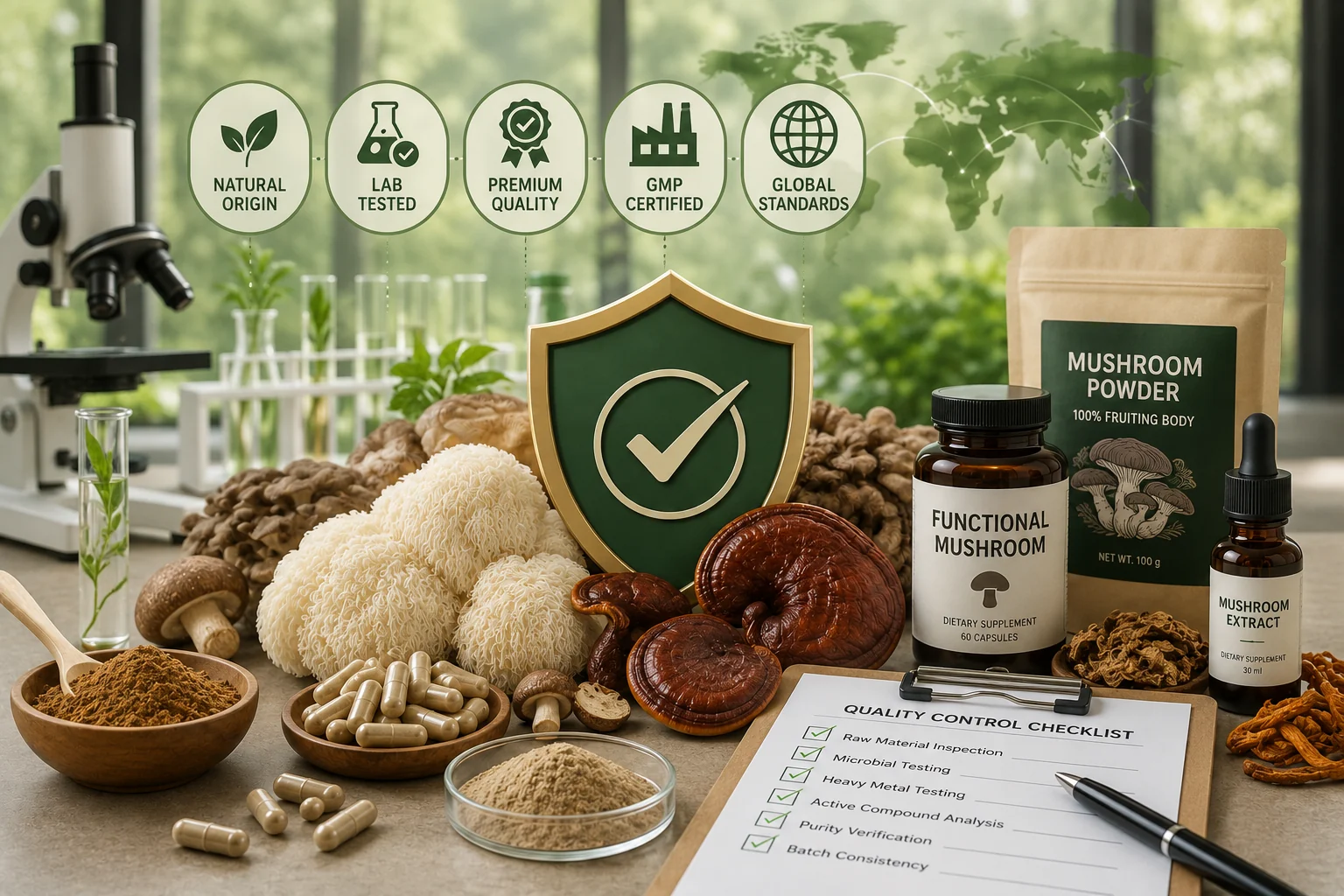
In the wholesale market, products are evaluated long before they reach the final consumer. Buyers compare manufacturers based on reliability, documentation, consistency, production processes, and quality management systems. A supplier may offer competitive pricing and fast production, but without stable quality standards it becomes difficult to maintain long-term commercial relationships.
For this reason, quality has become one of the most valuable assets in the functional mushroom industry. It protects manufacturers from production problems, helps distributors build customer confidence, and gives supplement brands the consistency needed to grow internationally.
Quality is not a single laboratory test performed before shipping. It is a management system that influences every decision made throughout production.
Quality Begins Before Manufacturing Starts
Many people associate quality control with laboratory testing after production is complete. In reality, quality management begins much earlier.
Before manufacturing starts, producers evaluate the materials that will be used throughout the production process.
This initial stage may include reviewing:
Raw material specifications
Supplier documentation
Product identity
Physical condition
Storage requirements
Batch records
Establishing quality standards before production reduces the possibility of problems appearing later in the manufacturing process.
Consistency Is Essential for Wholesale Business
Wholesale customers expect every shipment to match previous deliveries.
If one production batch differs significantly from the next, businesses may experience manufacturing difficulties, inventory complications, or customer complaints.
Consistency supports:
Stable production planning
Predictable manufacturing
Reliable product performance
Simplified inventory management
Long-term customer confidence
Manufacturers that maintain consistent production standards become more attractive long-term business partners.
Standard Operating Procedures Improve Reliability
Reliable manufacturing depends on repeatable processes rather than individual decisions.
Professional production facilities establish documented procedures for every major activity, including:
Material handling
Processing
Blending
Encapsulation
Packaging
Product inspection
Following standardized procedures reduces production variability while improving manufacturing efficiency.
This structured approach also makes it easier to train employees and maintain consistent product quality as production volumes increase.
Documentation Builds Commercial Confidence
Documentation is an important part of quality management because it provides transparency throughout the manufacturing process.
Wholesale buyers frequently request documents such as:
Certificate of Analysis (COA)
Product Specifications
Laboratory Reports
Batch Records
Manufacturing Information
Export Documentation
Providing complete documentation demonstrates that products have been manufactured under controlled conditions and allows buyers to make informed purchasing decisions.
Quality Supports International Trade
Exporting functional mushroom products requires more than manufacturing capability.
International buyers often evaluate suppliers based on their ability to provide reliable production records and consistent quality documentation.
Strong quality systems help manufacturers prepare for:
Export requirements
Customs procedures
Distributor evaluations
Retail partnerships
Long-term supply agreements
For businesses entering global markets, quality management becomes an important competitive advantage.
Every Department Contributes to Product Quality
Quality is not the responsibility of one laboratory or one department.
Every stage of business operations influences the finished product.
This includes:
Purchasing
Production
Packaging
Warehousing
Logistics
Documentation
Customer support
When every department follows the same quality philosophy, businesses reduce operational errors and improve overall efficiency.
Reliable Quality Strengthens Brand Reputation
For supplement brands, reputation is built over years but can be damaged by inconsistent products.
Customers expect every purchase to meet the same standards regardless of production date or destination market.
Consistent quality helps businesses:
Build customer loyalty
Reduce product complaints
Improve distributor confidence
Increase repeat orders
Support premium brand positioning
Strong quality management therefore contributes directly to long-term commercial success.
Quality Helps Businesses Scale
As companies grow, production volumes increase and operations become more complex.
Without standardized quality systems, expansion often creates inconsistency.
Manufacturers with established quality procedures can scale production while maintaining:
Manufacturing consistency
Product reliability
Operational efficiency
Documentation accuracy
Supply chain stability
This makes growth more predictable and reduces operational risk.
How Wholesale Buyers Can Evaluate Quality
Choosing a supplier requires more than reviewing product specifications.
Buyers should also evaluate how manufacturers manage quality throughout their operations.
Useful questions include:
How is production monitored?
Are manufacturing procedures standardized?
What documentation is available?
How are production records maintained?
How is consistency verified between batches?
What inspection procedures are followed before shipment?
The answers provide valuable insight into the manufacturer's overall management system.
Quality Creates Long-Term Partnerships
Wholesale relationships are rarely based on price alone.
Businesses remain with suppliers that consistently deliver reliable products, communicate transparently, and maintain professional manufacturing standards.
Manufacturers that prioritize quality often benefit from:
Higher customer retention
Larger repeat orders
Stronger distributor relationships
Better international reputation
Sustainable business growth
Quality therefore becomes an investment in future commercial success rather than simply a production requirement.
Conclusion
Quality standards are one of the defining characteristics of a successful functional mushroom manufacturer. They influence every stage of production, support international trade, strengthen customer confidence, and create the consistency required for long-term business growth.
For supplement brands, distributors, and wholesale buyers, selecting a manufacturer with well-established quality management systems is one of the most effective ways to reduce risk and build a dependable supply chain. In today's competitive functional mushroom industry, quality is not simply an advantage—it is the foundation on which lasting business partnerships are built.