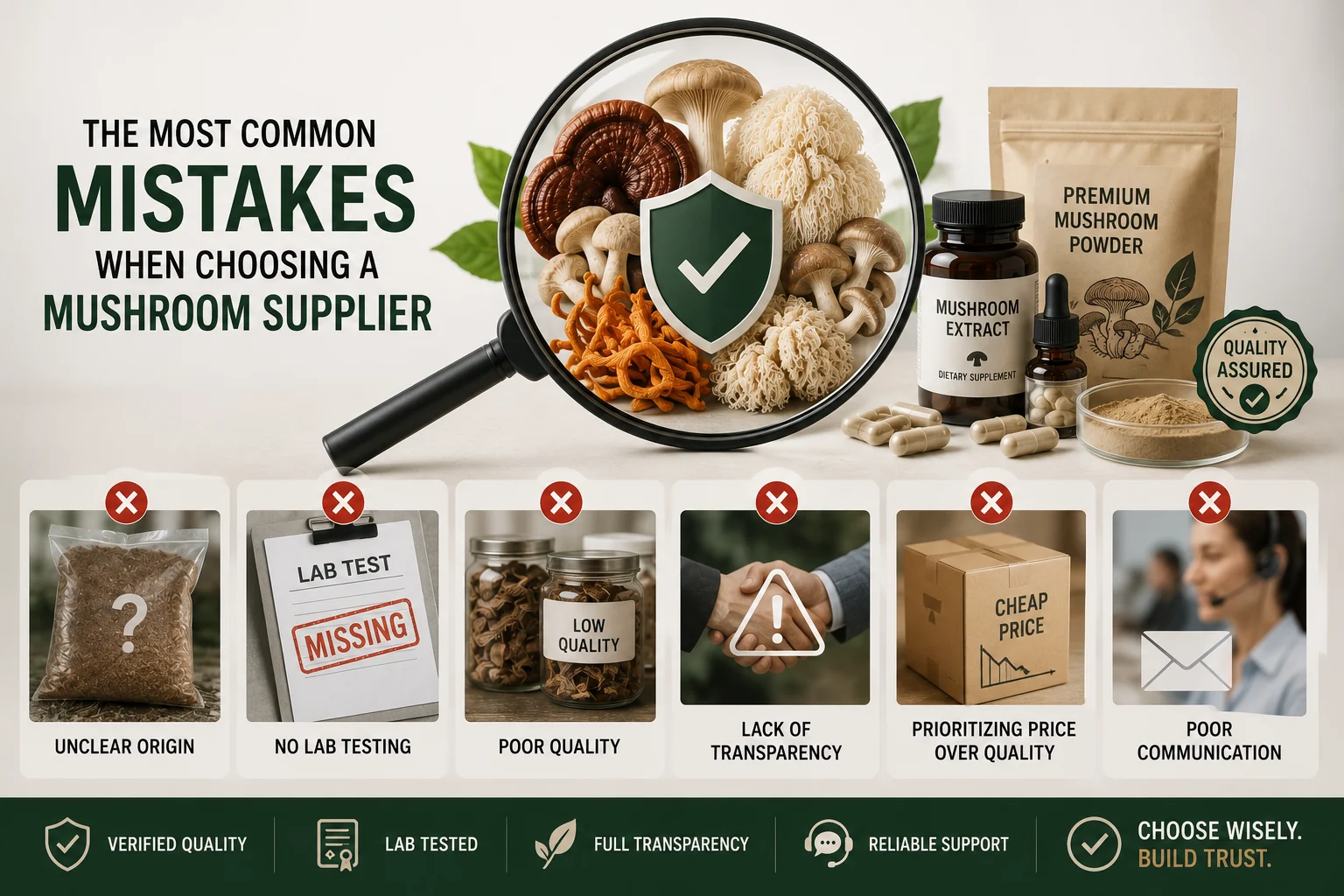
Finding a company that can sell mushroom products is relatively easy. Finding a supplier that can consistently support your business for years is much more challenging.
Many purchasing decisions are made under time pressure or based on incomplete information. At first, everything may appear satisfactory—a competitive price, an attractive catalog, and quick communication. However, the real quality of a supplier often becomes apparent only after production begins or the first shipment arrives.
Experienced wholesale buyers know that supplier selection should be viewed as a risk management process rather than a simple purchasing decision. Identifying potential problems before placing an order can save significant time, money, and resources.
Mistake 1: Focusing Only on the Lowest Price
One of the most common purchasing mistakes is selecting a supplier based solely on price.
A lower quotation may seem attractive, but pricing alone rarely reflects the overall value of a business partnership.
Instead of comparing only the cost per kilogram or per unit, evaluate:
Manufacturing standards
Production reliability
Product consistency
Available services
Documentation support
Delivery performance
The most cost-effective supplier is often the one that reduces operational problems rather than simply offering the lowest price.
Mistake 2: Ignoring Production Capacity
Some suppliers can successfully manufacture small orders but struggle when customers begin increasing volumes.
Before establishing a long-term relationship, determine whether the supplier can support future growth.
Important questions include:
What are the monthly production capabilities?
Can larger orders be accommodated?
How are production schedules managed?
Is additional manufacturing capacity available if demand increases?
A supplier that cannot scale alongside your business may eventually limit your expansion.
Mistake 3: Failing to Verify Product Consistency
Receiving one good shipment does not necessarily guarantee consistent quality in future orders.
Professional buyers evaluate how manufacturers maintain consistency between production batches.
Areas worth discussing include:
Standardized manufacturing procedures
Batch control systems
Internal quality inspections
Production documentation
Traceability processes
Consistency is particularly important for businesses building long-term customer relationships.
Mistake 4: Overlooking Communication Quality
Communication is often underestimated during supplier evaluation.
However, clear and responsive communication becomes essential when discussing:
Product specifications
Production schedules
Packaging requirements
Documentation
Shipping arrangements
Future product development
A supplier that responds quickly, provides accurate information, and resolves questions efficiently is often easier to work with than one offering slightly lower prices but poor communication.
Mistake 5: Not Reviewing Documentation Early
Documentation should never become an afterthought.
Before production begins, buyers should understand which commercial and technical documents can be provided.
These may include:
Certificate of Analysis (COA)
Product Specifications
Laboratory Reports
Commercial Invoice
Packing List
Export Documents
Reviewing documentation before placing an order reduces the risk of customs issues and regulatory complications later.
Mistake 6: Choosing a Supplier with a Limited Product Range
Some businesses initially purchase only one product.
As they grow, they often wish to expand into additional product categories.
Working with a manufacturer that offers multiple product formats makes future expansion significantly easier.
A diversified supplier may produce:
Mushroom powders
Mushroom extracts
Liquid extracts
Capsules
Tablets
Gummies
Functional beverages
Private Label products
Having one manufacturing partner simplifies purchasing and logistics while reducing supplier management.
Mistake 7: Ignoring Lead Times
Production time is just as important as product quality.
Businesses should understand:
Average production time
Order scheduling procedures
Seasonal demand fluctuations
Shipping timelines
Inventory planning recommendations
Realistic lead-time expectations improve purchasing decisions and reduce supply interruptions.
Mistake 8: Thinking Only About the First Order
Many companies negotiate only their immediate purchase.
Successful businesses think much further ahead.
Ask yourself:
Can this supplier support us next year?
Can they manufacture additional products?
Can they help with Private Label expansion?
Will they remain competitive as volumes increase?
Long-term planning often leads to stronger commercial partnerships.
Mistake 9: Overlooking Technical Support
An experienced manufacturer contributes more than manufacturing capacity.
Good suppliers frequently assist with:
Product selection
Packaging recommendations
Manufacturing advice
Product development
Export planning
Production optimization
Technical guidance becomes increasingly valuable as businesses introduce new products or enter new markets.
Mistake 10: Treating the Supplier as a Vendor Instead of a Partner
The strongest wholesale relationships are collaborative.
Manufacturers that understand your business goals can often recommend better production schedules, more efficient packaging solutions, and opportunities for future expansion.
Companies that build long-term partnerships usually benefit from:
More efficient communication
Better production planning
Greater manufacturing flexibility
Improved supply reliability
Stronger commercial cooperation
Viewing the supplier as a strategic partner creates value beyond the products themselves.
A Simple Evaluation Checklist
Before selecting a wholesale mushroom supplier, review the following questions:
вњ” Does the manufacturer have experience with international wholesale orders?
вњ” Can production scale as your business grows?
вњ” Is documentation available for commercial shipments?
вњ” Are multiple product formats offered?
вњ” Is communication clear and responsive?
вњ” Are production timelines realistic?
вњ” Can the supplier support future product expansion?
вњ” Does the company appear interested in long-term cooperation rather than one-time sales?
If most of these questions can be answered positively, you are more likely to establish a stable and productive business relationship.
Conclusion
Choosing a functional mushroom supplier is one of the most strategic decisions a supplement brand or wholesale distributor will make. The best partnerships are built on consistency, transparency, communication, and the ability to grow together over time.
Rather than selecting a supplier based solely on pricing, businesses should evaluate manufacturing capabilities, quality systems, documentation, scalability, and long-term support. Companies that avoid the common mistakes outlined in this guide are better positioned to build resilient supply chains, strengthen customer confidence, and achieve sustainable growth in the global functional mushroom market.
Checking a potential supplier? Review our product documentation, delivery process and available wholesale formats.