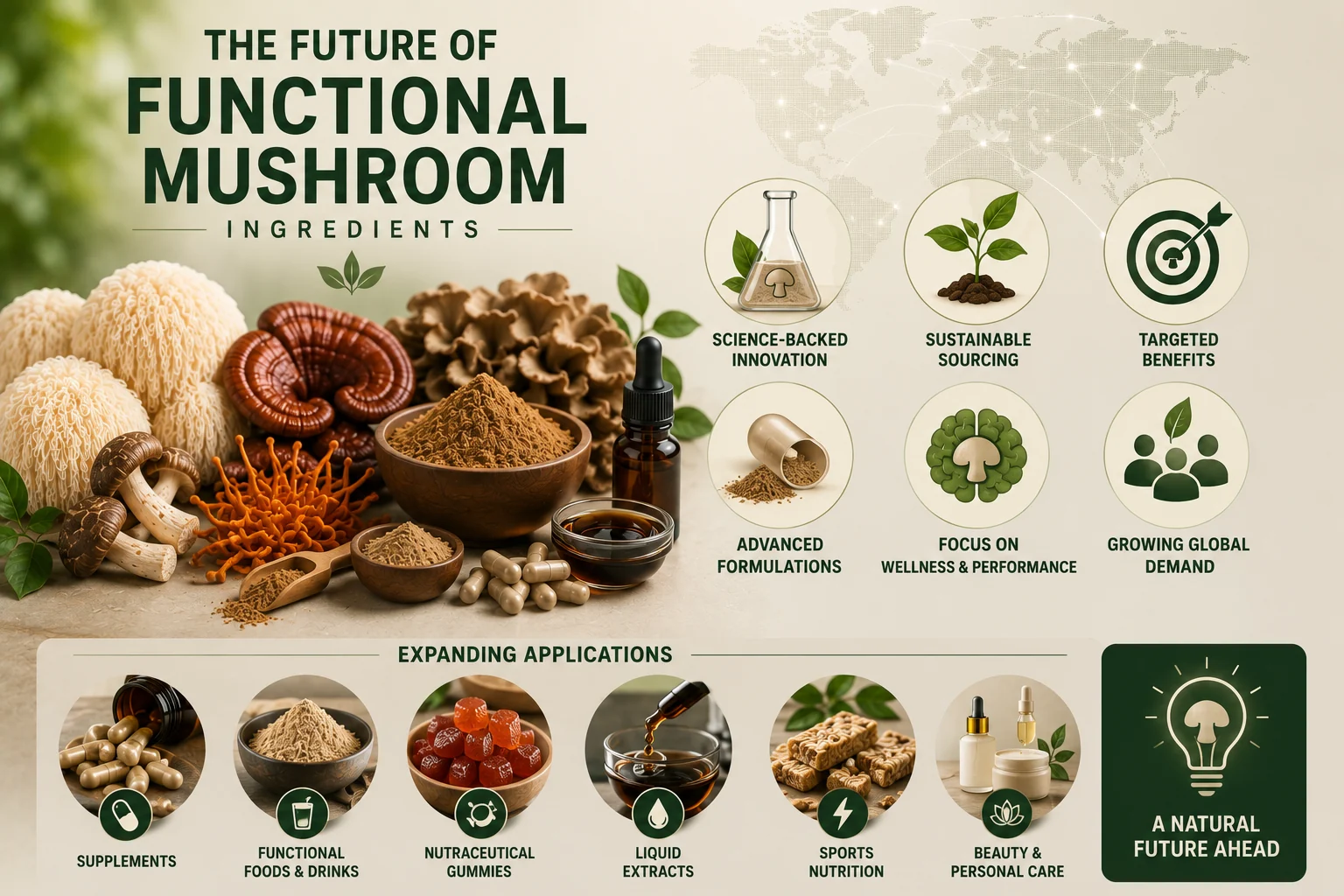
The functional mushroom industry is entering a new stage of development. While the first generation of mushroom supplements focused primarily on a limited number of traditional products, today's market is driven by innovation, ingredient specialization, and advanced manufacturing technologies.
Businesses are no longer searching only for mushroom powders or capsules. They are looking for premium ingredients that can be incorporated into a wide variety of commercial products while meeting the growing expectations of consumers, retailers, and international distributors.
For manufacturers, this evolution creates opportunities to develop new production methods, improve ingredient quality, and expand into entirely new product categories.
Functional Mushrooms Are Becoming Mainstream Ingredients
Only a few years ago, functional mushrooms were considered a specialized category within the dietary supplement industry.
Today, they are increasingly used by companies producing:
Dietary supplements
Functional foods
Nutritional beverages
Sports nutrition
Wellness products
Premium ingredient blends
Ready-to-drink products
Health-focused consumer goods
This broader adoption is transforming mushroom ingredients from niche products into widely recognized commercial raw materials.
As demand grows, manufacturers are investing in larger production capacity and more efficient processing technologies.
Innovation Is Driving Ingredient Development
Future growth will not depend only on producing larger volumes.
Manufacturers are focusing on improving the ingredients themselves through innovation.
Current development areas include:
Higher ingredient consistency
Improved extraction technologies
Better ingredient standardization
Enhanced product stability
More efficient manufacturing processes
Cleaner production methods
Advanced drying technologies
Improved blending techniques
These improvements help manufacturers deliver ingredients that are easier to formulate into different commercial products.
Demand for Specialized Ingredients Is Increasing
Businesses increasingly require ingredients designed for specific manufacturing applications rather than one universal solution.
Instead of purchasing a single mushroom extract for every product, companies often request ingredients optimized for:
Capsules
Tablets
Gummies
Beverage production
Bulk powder formulations
Liquid supplements
Functional snack products
Sports nutrition
This specialization allows manufacturers to provide more precise solutions for different product categories.
Ingredient Transparency Is Becoming More Important
Wholesale buyers expect greater transparency throughout the manufacturing process.
Modern supplement brands increasingly request detailed information about:
Raw material sourcing
Manufacturing methods
Production consistency
Laboratory testing
Batch traceability
Product specifications
Quality management systems
Providing clear technical information strengthens confidence between manufacturers and commercial buyers while supporting long-term partnerships.
Custom Formulations Will Continue to Expand
Standard ingredients remain important, but many supplement brands are moving toward customized formulations.
Future ingredient development will likely include:
Exclusive mushroom blends
Customer-specific formulations
Multi-ingredient systems
Industry-specific products
Premium extract combinations
Customized manufacturing solutions
This shift allows brands to develop products that better reflect their identity while reducing direct competition.
Manufacturing Technology Continues to Advance
Modern production facilities are becoming increasingly automated.
Investment in advanced manufacturing equipment improves:
Production efficiency
Batch consistency
Product accuracy
Manufacturing capacity
Packaging speed
Quality monitoring
Automation also allows manufacturers to respond more quickly to growing international demand while maintaining consistent production standards.
Sustainability Will Influence Ingredient Production
Environmental responsibility is becoming an important factor in supplier selection.
Many wholesale customers evaluate manufacturers based on their approach to:
Resource efficiency
Waste reduction
Packaging materials
Production optimization
Supply chain management
Manufacturers that invest in sustainable production practices may become more attractive partners for international brands focused on long-term environmental goals.
Global Supply Chains Will Become More Integrated
International cooperation between manufacturers, distributors, and supplement brands continues to expand.
Rather than working with multiple suppliers, many businesses now prefer long-term manufacturing partnerships capable of providing:
Multiple product categories
Flexible production
Stable inventory
Consistent quality
Global shipping
Technical support
Integrated supply chains simplify operations while reducing purchasing complexity.
The Role of Manufacturers Is Changing
Manufacturers are no longer viewed simply as production facilities.
Many now act as strategic partners by supporting:
Product development
Formula optimization
Packaging selection
Production planning
Technical consultation
International logistics
Product portfolio expansion
This broader role creates stronger commercial relationships and allows supplement brands to accelerate business growth.
Preparing for the Next Generation of Mushroom Products
Businesses planning long-term growth should consider how ingredient trends may influence future product development.
Companies that invest today in flexible manufacturing partnerships, diversified product portfolios, and scalable supply chains will be better prepared to respond to future market opportunities.
Forward-thinking brands are already designing product strategies that allow them to introduce new ingredient formats without disrupting existing manufacturing operations.
Conclusion
The future of functional mushroom ingredients will be shaped by innovation, manufacturing excellence, and increasing global demand. As businesses continue expanding into new product categories, manufacturers capable of delivering consistent quality, customized solutions, and advanced production capabilities will play an increasingly important role in the industry's development.
For wholesale buyers, supplement brands, and distributors, understanding these long-term trends provides valuable insight when selecting manufacturing partners and planning future product portfolios. Companies that adapt to changing ingredient technologies and build strong relationships with experienced manufacturers will be best positioned for sustainable growth in the evolving functional mushroom market.