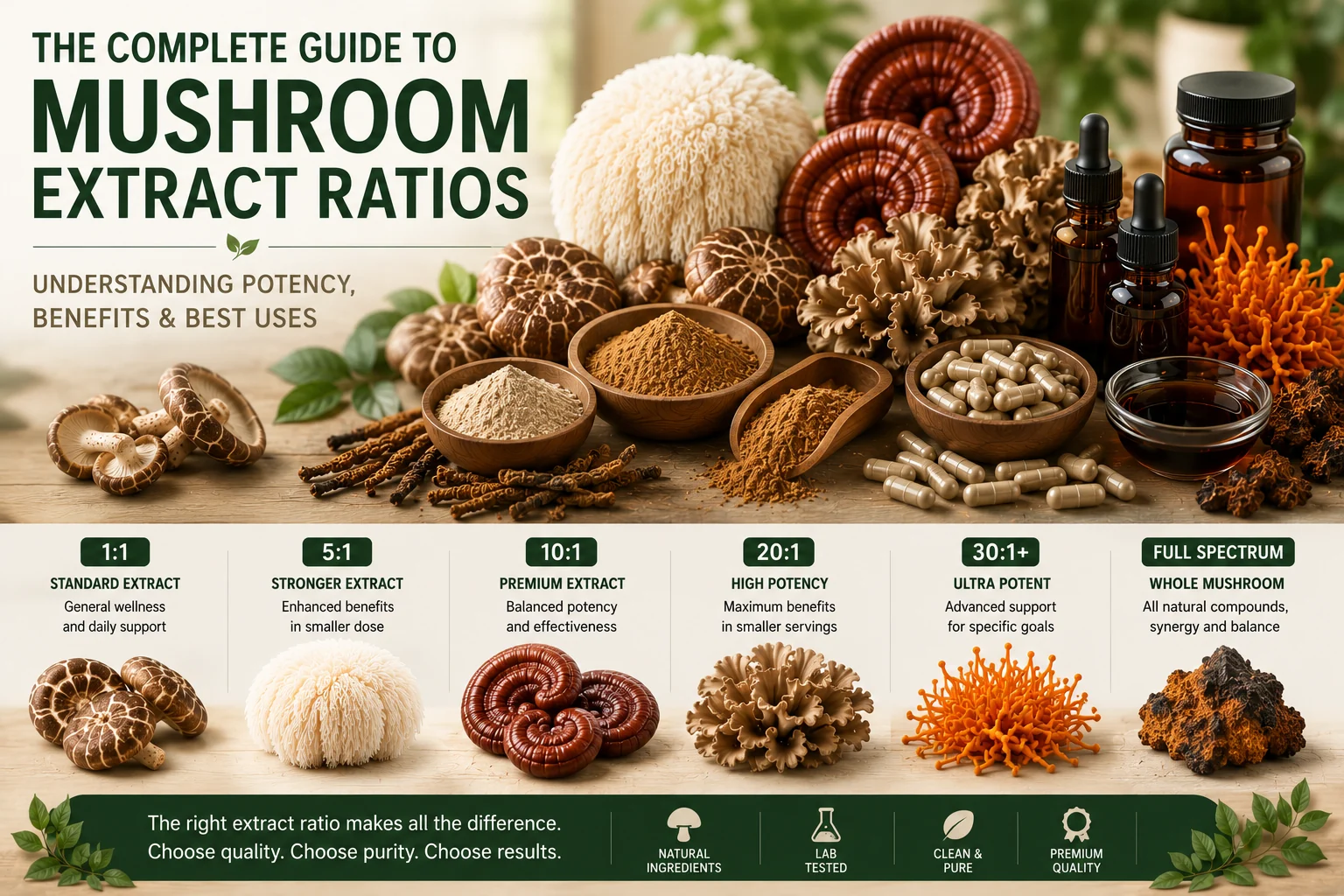
Walk through almost any ingredient catalog and you will find mushroom extracts labeled as 4:1, 8:1, 10:1, 20:1, 30:1 or even higher. At first glance these numbers appear to indicate that a larger ratio always means a stronger or better ingredient. In reality, extraction ratios tell only part of the story.
For supplement manufacturers, distributors, and wholesale buyers, understanding how extraction ratios are created is essential when comparing suppliers, evaluating product specifications, and selecting ingredients for commercial production.
Knowing how to interpret these values helps businesses purchase mushroom extracts based on technical requirements rather than marketing claims.
What Is a Mushroom Extract Ratio?
An extraction ratio describes the relationship between the amount of dried mushroom used during production and the amount of finished extract that remains after processing.
For example, an 8:1 extract generally means that eight parts of dried mushroom material were used to produce one part of finished extract.
The ratio describes the manufacturing process rather than the effectiveness of the finished ingredient. Two extracts carrying the same ratio may still differ significantly because of raw material quality, extraction methods, processing conditions, and standardization.
For this reason, experienced wholesale buyers evaluate extraction ratios together with laboratory specifications instead of relying on the ratio alone.
Why Are Mushroom Extracts Produced?
Whole mushroom powder and mushroom extracts are manufactured for different purposes.
Grinding creates a powder that contains the entire dried mushroom. Extraction, on the other hand, is a refining process designed to concentrate selected naturally occurring compounds while removing a large portion of the indigestible mushroom structure.
The result is an ingredient that is easier to formulate into capsules, tablets, gummies, beverages, and other supplement products.
This is why mushroom extracts have become one of the most widely used ingredients in modern nutraceutical manufacturing.
Why Higher Ratios Do Not Always Mean Better Quality
One of the most common misconceptions in the supplement industry is that higher extraction ratios automatically indicate superior products.
In reality, the ratio itself does not measure purity, manufacturing quality, or ingredient consistency.
A premium extract depends on many additional factors, including:
quality of the raw mushrooms;
extraction technology;
production controls;
filtration methods;
drying techniques;
laboratory verification;
manufacturing consistency.
Because of this, professional buyers rarely compare products based on extraction ratios alone.
Factors That Influence Extract Quality
When evaluating mushroom extracts, manufacturers usually review several technical characteristics together.
Important considerations include:
mushroom species;
part of the mushroom used;
production method;
extraction process;
batch consistency;
moisture level;
particle size;
laboratory documentation;
production standards.
Looking at the complete specification provides a much more accurate picture than focusing only on the extraction ratio.
Common Extraction Ratios Used in Commercial Manufacturing
Wholesale manufacturers produce extracts in many different concentrations depending on customer requirements.
Frequently available commercial ratios include:
4:1
8:1
10:1
12:1
15:1
20:1
30:1
The appropriate ratio depends on the intended formulation, dosage, manufacturing process, and target market rather than on the assumption that the highest number is always preferable.
Choosing the Right Extract for Your Product
Different supplement formats require different ingredient characteristics.
When selecting mushroom extracts, businesses should consider:
final product type;
serving size;
capsule or tablet capacity;
formulation objectives;
production efficiency;
ingredient compatibility;
regulatory requirements.
A technical discussion with the manufacturer often helps identify the most suitable extract specification for a particular product.
Questions Wholesale Buyers Should Ask
Before purchasing mushroom extracts, professional buyers typically request additional information beyond the extraction ratio.
Useful questions include:
Which extraction method was used?
Is the extract standardized?
What laboratory documentation is available?
How is batch consistency maintained?
What quality control procedures are followed?
Is the extract suitable for capsules, tablets, gummies, or beverages?
What packaging options are available for wholesale orders?
These questions provide valuable insight into manufacturing quality and supplier reliability.
Why Manufacturers Should Explain Extract Ratios Clearly
Transparent communication helps businesses make informed purchasing decisions.
Experienced manufacturers explain not only the extraction ratio but also the production process, available documentation, intended applications, and manufacturing capabilities.
Providing detailed technical information builds trust and simplifies product development for supplement brands and distributors.
Conclusion
Extraction ratios are an important technical specification, but they should never be viewed as the only indicator of product quality. For wholesale buyers, understanding how mushroom extracts are produced and how extraction ratios relate to manufacturing processes leads to better purchasing decisions and more reliable product development.
The best manufacturing partners provide clear documentation, consistent production standards, and technical guidance that allows businesses to select the most appropriate mushroom extracts for their formulations. By evaluating extraction ratios together with overall manufacturing quality, supplement brands can build products that meet both commercial expectations and long-term market demands.