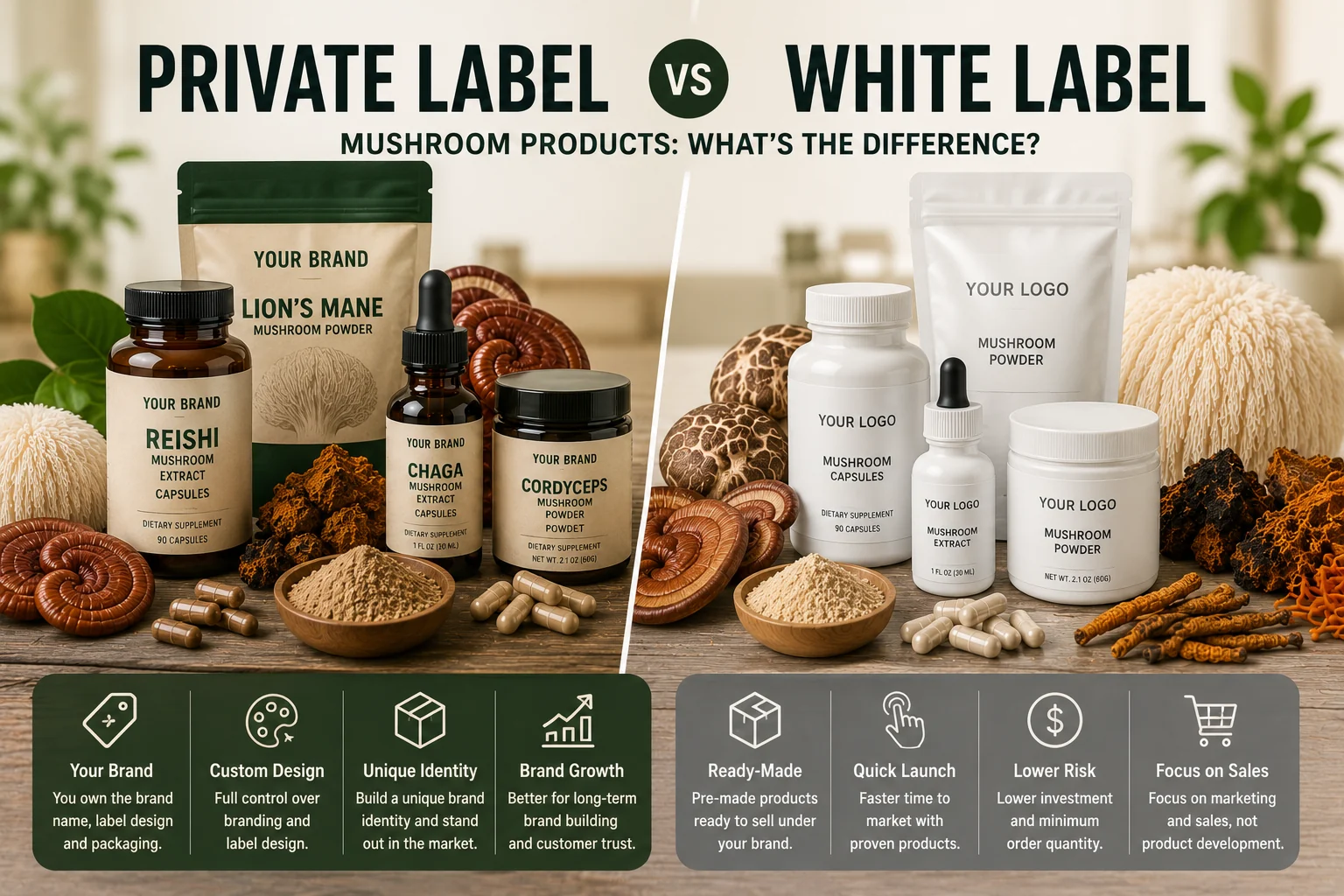
As the global functional mushroom market continues to grow, more businesses are entering the industry by partnering with experienced wholesale manufacturers instead of building their own production facilities. This approach significantly reduces investment costs while allowing companies to launch new products much faster.
Two manufacturing models dominate the industry: Private Label and White Label. Although these terms are often used interchangeably, they represent different production strategies and offer unique advantages depending on the needs of the business.
Choosing the right model is an important decision that affects product uniqueness, development time, production costs, and long-term brand positioning.
What Is Private Label Manufacturing?
Private Label manufacturing is a business model in which a manufacturer produces mushroom products specifically for one customer's brand.
The customer has greater control over the final product and can often customize:
Product formulas
Ingredient combinations
Mushroom species
Dosage
Packaging
Label design
Product size
Branding
Product positioning
Private Label allows companies to create products that reflect their own brand identity while offering something different from competitors.
This model is commonly chosen by businesses that want to build a long-term brand with unique products and greater market differentiation.
What Is White Label Manufacturing?
White Label manufacturing follows a simpler approach.
The manufacturer produces standard products using existing formulas, while different companies sell those products under their own brand names.
With White Label production, businesses typically customize:
Brand name
Product label
Packaging design
The product formulation itself usually remains unchanged.
Because development has already been completed, White Label products can often be launched much faster than Private Label products.
This option is popular among companies that want to enter the market quickly while minimizing development costs.
Key Differences Between Private Label and White Label
Although both manufacturing models allow businesses to sell products under their own brand, several important differences exist.
Private Label
Custom product formulations
Greater flexibility
Exclusive products
Unique brand positioning
Longer development process
Higher customization level
Better product differentiation
White Label
Standard formulations
Faster production
Lower development costs
Simpler launch process
Limited customization
Shared product formulas
Faster market entry
The right choice depends on business objectives, available budget, and long-term growth strategy.
Which Model Is Better for New Supplement Brands?
For companies entering the functional mushroom market for the first time, both models offer significant advantages.
White Label manufacturing is often ideal for businesses that want to:
Launch products quickly
Test market demand
Reduce initial investment
Build brand awareness
Expand product offerings rapidly
Private Label manufacturing may be a better option for companies planning to build a distinctive premium brand with customized formulations and long-term market positioning.
Many successful supplement companies begin with White Label products before transitioning to fully customized Private Label formulations as their business grows.
Benefits of Private Label Mushroom Products
Private Label manufacturing provides businesses with greater control over every aspect of product development.
Advantages include:
Unique formulations
Exclusive products
Stronger brand identity
Flexible ingredient selection
Customized dosages
Product innovation
Higher market differentiation
Greater pricing flexibility
Long-term competitive advantages
Private Label is particularly attractive for companies seeking to establish themselves as premium supplement brands.
Benefits of White Label Mushroom Products
White Label manufacturing focuses on speed, simplicity, and efficiency.
Major advantages include:
Faster product launches
Lower startup costs
Proven formulations
Simplified production
Reduced development time
Faster inventory replenishment
Easy product portfolio expansion
Lower operational risk
For many businesses, White Label manufacturing provides an efficient way to begin selling mushroom supplements while minimizing complexity.
Can Businesses Transition from White Label to Private Label?
Yes.
Many companies use White Label products as a starting point before investing in custom product development.
As sales increase and customer demand grows, businesses often introduce Private Label formulations that better reflect their long-term branding strategy.
This gradual approach allows companies to build market experience while reducing financial risk during the early stages of business development.
Choosing the Right Manufacturing Partner
Whether selecting Private Label or White Label production, choosing the right manufacturer remains one of the most important business decisions.
An experienced manufacturing partner should provide:
High production standards
Reliable quality control
Flexible manufacturing capacity
Product development support
Packaging solutions
Regulatory documentation
International shipping
Long-term production stability
A reliable manufacturer can support business growth regardless of which manufacturing model is selected.
Which Option Is Right for Your Business?
There is no universal answer.
Businesses seeking rapid market entry with minimal development costs often benefit from White Label manufacturing.
Companies focused on long-term brand building, product innovation, and market differentiation usually choose Private Label manufacturing.
Many successful supplement brands combine both approaches by using White Label products for fast expansion while simultaneously developing exclusive Private Label product lines.
Conclusion
Private Label and White Label manufacturing both play an important role in today's functional mushroom industry. Each model offers unique advantages depending on a company's business goals, budget, and growth strategy.
Understanding the differences between these manufacturing options helps businesses make informed decisions, reduce development risks, and build successful mushroom product lines. By partnering with an experienced wholesale functional mushroom manufacturer, companies can choose the production model that best supports their current needs while creating opportunities for future expansion and long-term success.
Deciding which model fits your brand? Explore our available product formats or describe your brand, market and volume requirements for a tailored response.