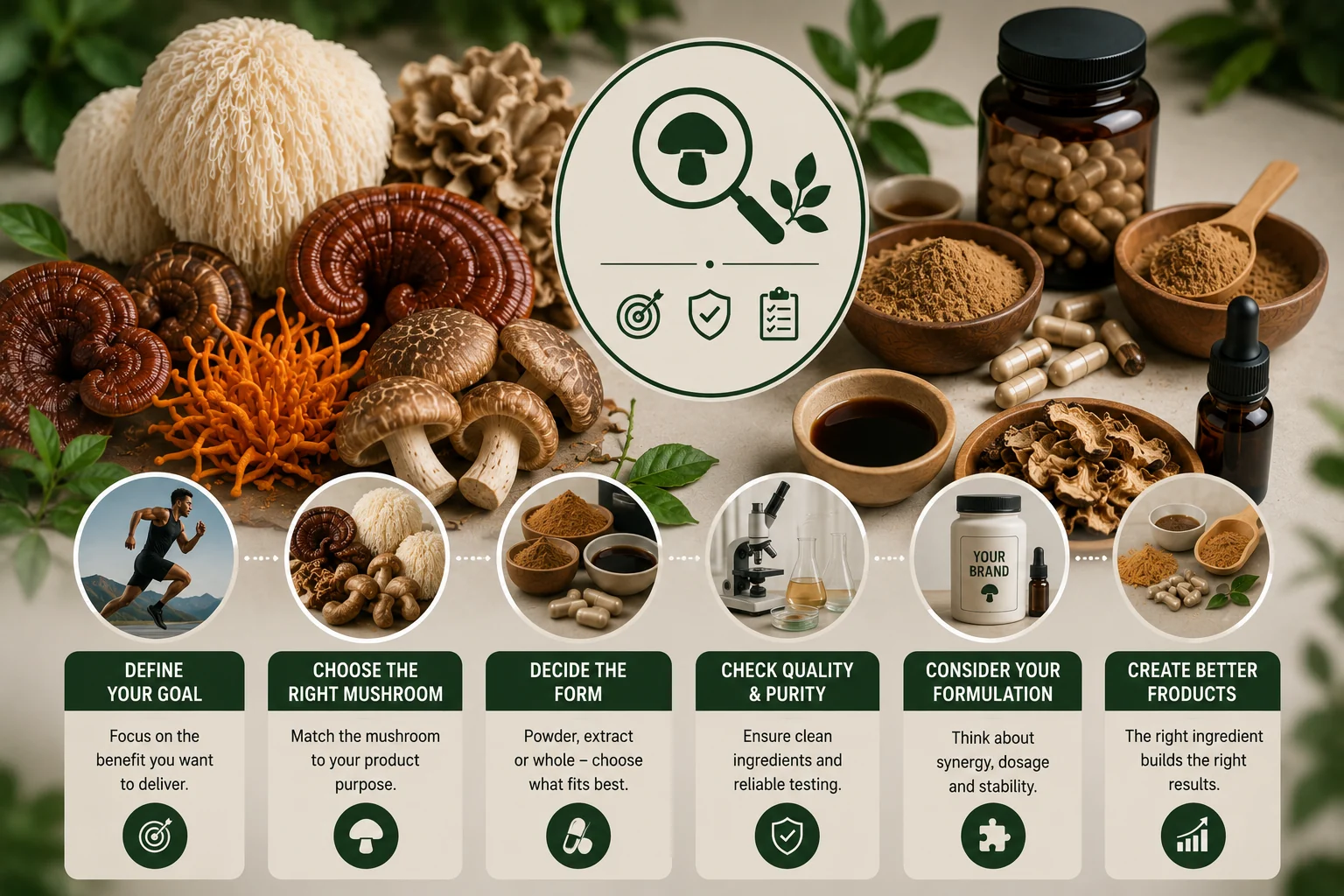
Developing a successful mushroom-based product begins long before manufacturing starts. The foundation of every supplement is the ingredient itself, and selecting the wrong one can create unnecessary production challenges, increase costs, and limit future product opportunities.
Today, manufacturers offer dozens of mushroom species, multiple extract types, various ingredient formats, and customized manufacturing options. While this variety creates flexibility, it also requires businesses to make informed decisions before launching production.
Instead of asking, "Which mushroom is the best?", successful brands ask a different question:
"Which ingredient is the best fit for the product we want to create?"
This approach leads to better formulations, smoother manufacturing, and stronger commercial results.
Define the Purpose of Your Product
The first step is understanding what you are planning to manufacture.
Different product concepts require different ingredient characteristics.
For example, your product may be designed as:
A dietary supplement
A powdered drink
A capsule
A tablet
A liquid extract
A gummy
A functional beverage
A sports nutrition formula
The final product format often determines which ingredient type will perform best during manufacturing.
Starting with the end product rather than the ingredient simplifies the entire development process.
Select the Appropriate Mushroom Species
Every mushroom species has its own commercial applications and market positioning.
Some brands build their portfolio around a single species, while others create products containing several mushrooms in one formulation.
Wholesale manufacturers commonly produce ingredients from:
Lion's Mane
Reishi
Chaga
Cordyceps Militaris
Turkey Tail
Shiitake
Maitake
Tremella
Agaricus Blazei
Amanita Muscaria
Amanita Pantherina
The most suitable species depends on your target market, product concept, and overall brand strategy rather than current market trends alone.
Decide Between Powder and Extract
One of the earliest technical decisions involves selecting the ingredient type.
Both powders and extracts are widely used in commercial manufacturing, but they serve different production purposes.
Powders are often selected when manufacturers require:
versatile raw materials;
bulk ingredient applications;
beverage formulations;
custom blending.
Extracts are frequently chosen when products require:
concentrated ingredients;
standardized specifications;
premium positioning;
specialized formulations.
Understanding these differences helps businesses choose ingredients that align with their manufacturing process.
Think About Manufacturing Compatibility
Not every ingredient performs equally well in every production environment.
Before finalizing a formulation, manufacturers evaluate how ingredients behave during:
blending;
encapsulation;
tableting;
beverage production;
packaging;
storage.
Selecting ingredients compatible with the intended manufacturing process improves efficiency while reducing production adjustments.
Match Ingredients to Your Business Model
Different businesses require different ingredient strategies.
For example:
Supplement Brands
Often require finished ingredients ready for encapsulation or packaging.
Contract Manufacturers
Typically purchase bulk ingredients suitable for multiple customer formulations.
Private Label Companies
Frequently prefer ingredients already integrated into finished products.
Ingredient Distributors
Usually focus on standardized raw materials supplied in bulk packaging.
Understanding your own business model helps determine the most practical purchasing strategy.
Consider Future Product Expansion
Choosing ingredients is not only about today's product.
Successful brands often select ingredients that allow future portfolio growth.
A single mushroom ingredient may later appear in:
Capsules
Powders
Gummies
Functional beverages
Premium product collections
Multi-mushroom blends
Planning for future expansion creates greater manufacturing flexibility while reducing future development costs.
Evaluate Supplier Capabilities
The quality of the ingredient depends heavily on the manufacturer producing it.
Rather than comparing products alone, businesses should evaluate supplier capabilities such as:
production capacity;
manufacturing experience;
quality systems;
available documentation;
technical support;
product consistency;
packaging options.
An experienced manufacturer can also recommend ingredient solutions based on commercial requirements rather than simply supplying existing products.
Balance Quality, Cost, and Scalability
Every purchasing decision involves balancing multiple business factors.
The most expensive ingredient is not always the best choice, and the lowest price does not necessarily provide the greatest value.
Successful wholesale buyers evaluate:
manufacturing quality;
production consistency;
long-term availability;
supply reliability;
commercial pricing;
scalability.
Looking beyond unit price often results in stronger long-term business performance.
Avoid Common Ingredient Selection Mistakes
Many companies encounter unnecessary challenges because they focus only on specifications instead of the complete manufacturing process.
Common mistakes include:
selecting ingredients before defining the product;
ignoring manufacturing compatibility;
comparing suppliers only by price;
overlooking future expansion;
choosing manufacturers with limited production capacity;
failing to review technical documentation.
Avoiding these issues simplifies product development and reduces operational risk.
Build Your Product Around the Right Ingredient
The most successful supplement brands do not force ingredients into existing products.
Instead, they design products around ingredients that support manufacturing efficiency, commercial objectives, and future growth.
This approach produces stronger product portfolios while creating better long-term relationships with manufacturing partners.
By selecting the right ingredient at the beginning of development, businesses reduce production complexity and improve overall product consistency.
Conclusion
Selecting the right mushroom ingredient requires more than choosing a popular mushroom species. Businesses must consider product format, manufacturing process, ingredient type, future portfolio expansion, supplier capabilities, and long-term commercial objectives.
Working closely with an experienced wholesale functional mushroom manufacturer allows supplement brands, distributors, and private label companies to identify ingredient solutions that support efficient production, reliable quality, and sustainable business growth. The right ingredient becomes the foundation of a successful product, while the right manufacturing partner helps transform that ingredient into a competitive solution for the global marketplace.
Ready to narrow down your specification? Review our mushroom species and formats and supporting product documentation.