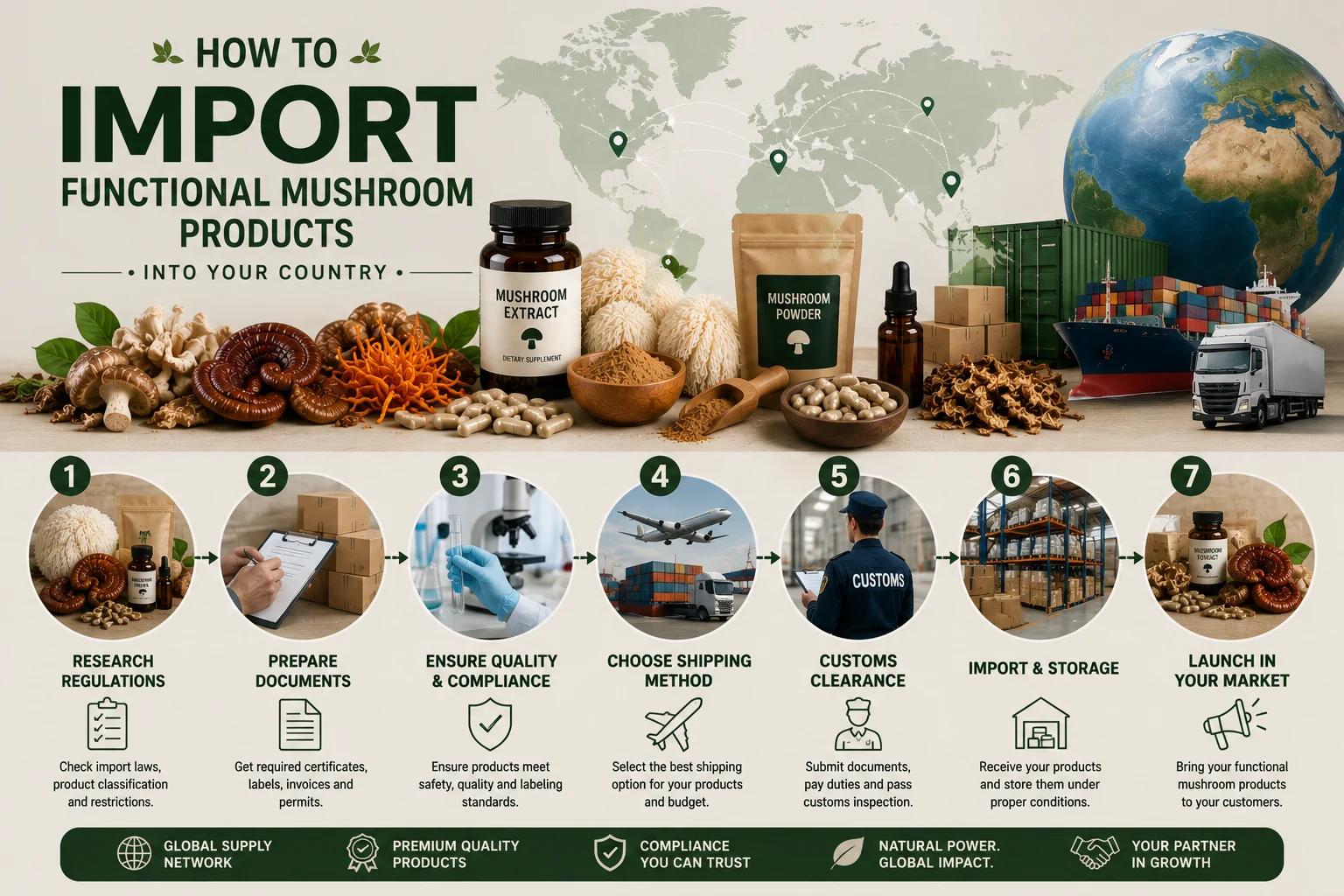
International trade has made it easier than ever for companies to source premium functional mushroom products from experienced manufacturers around the world. Whether a business is purchasing bulk mushroom powders, standardized extracts, capsules, tablets, gummies, or finished private label products, importing can provide access to competitive pricing, advanced manufacturing capabilities, and scalable production.
However, importing dietary supplement ingredients is not simply a matter of placing an order. Every shipment passes through several stages involving supplier verification, product documentation, transportation, customs clearance, and local distribution.
Businesses that prepare for these stages in advance can reduce delays, avoid unnecessary costs, and establish long-term supply relationships with trusted manufacturing partners.
Define the Products You Want to Import
The first step is identifying exactly which products your business requires.
Different companies import different categories depending on their business model.
Common wholesale products include:
Mushroom powders
Mushroom extracts
Liquid extracts
Capsules
Tablets
Gummies
Functional beverages
Bulk ingredients
Private Label products
White Label products
Clearly defining product specifications before contacting manufacturers simplifies quotations, production planning, and logistics.
Research Import Requirements in Your Country
Every country has its own import regulations for dietary supplements and food ingredients.
Before placing a wholesale order, businesses should review:
import regulations;
customs procedures;
labeling requirements;
documentation requirements;
ingredient restrictions;
product registration rules;
packaging regulations.
Understanding local requirements early helps prevent customs delays and unexpected compliance issues.
Choose a Reliable Manufacturing Partner
The success of an international shipment begins with selecting the right supplier.
A professional manufacturer should demonstrate experience in export operations and provide clear communication throughout the process.
When comparing manufacturers, consider:
manufacturing experience;
export history;
product range;
production capacity;
quality control systems;
documentation support;
international logistics experience.
An experienced exporter understands the practical requirements of international trade and can assist customers throughout the shipping process.
Confirm Product Specifications
Before production begins, both parties should agree on detailed product specifications.
These may include:
product type;
mushroom species;
extract ratio;
dosage;
packaging format;
labeling requirements;
carton dimensions;
production quantity.
Clear specifications reduce misunderstandings and ensure the finished products meet commercial expectations.
Request the Necessary Documentation
Documentation is one of the most important aspects of international wholesale trade.
Depending on the destination country, businesses may require:
Commercial Invoice
Packing List
Certificate of Analysis (COA)
Product Specification Sheet
Certificate of Origin (when applicable)
Export documentation
Laboratory test reports
Preparing documentation before shipment helps customs authorities process imports more efficiently.
Select the Most Suitable Shipping Method
International manufacturers usually offer several transportation options.
The most common methods include:
Air freight
Sea freight
Road transportation
Express courier services
The most suitable option depends on:
shipment size;
delivery timeline;
destination country;
transportation budget;
product type.
Businesses often balance speed and transportation costs when selecting shipping methods.
Prepare for Customs Clearance
Every imported shipment must pass customs inspection before entering the destination country.
To simplify customs clearance, businesses should ensure that:
documentation is complete;
product descriptions are accurate;
shipping information matches commercial documents;
packaging is properly labeled.
Good preparation significantly reduces the likelihood of customs delays.
Plan Inventory Before Ordering
Successful importing requires more than transportation.
Businesses should calculate future inventory requirements before placing large wholesale orders.
Important planning considerations include:
projected sales volume;
warehouse capacity;
lead time;
production schedule;
shipping time;
seasonal demand.
Effective inventory planning reduces storage costs while minimizing the risk of product shortages.
Build a Long-Term Supply Chain
Importing should be viewed as an ongoing partnership rather than a single transaction.
Businesses benefit from developing long-term relationships with manufacturers that consistently deliver:
reliable quality;
predictable lead times;
stable pricing;
responsive communication;
flexible production;
scalable manufacturing.
Strong supplier relationships often improve operational efficiency and simplify future purchasing.
Common Challenges When Importing
International trade occasionally presents unexpected challenges.
Some of the most common include:
incomplete documentation;
inaccurate product specifications;
communication misunderstandings;
shipping delays;
customs inspections;
changing import regulations.
Working with experienced manufacturers helps minimize these risks through better planning and documentation.
Why Many Businesses Source Directly from Manufacturers
Buying directly from a wholesale manufacturer provides several commercial advantages.
These include:
lower purchasing costs;
direct communication;
greater production flexibility;
customized products;
consistent manufacturing quality;
easier technical support;
stronger long-term partnerships.
Direct cooperation also allows businesses to respond more quickly when expanding product lines or increasing order volumes.
Conclusion
Importing functional mushroom products successfully requires careful preparation, reliable documentation, and cooperation with an experienced manufacturing partner. By understanding local import requirements, confirming product specifications, selecting appropriate shipping methods, and establishing long-term supplier relationships, businesses can build an efficient international supply chain that supports sustainable growth.
For supplement brands, distributors, wholesalers, and private label companies, importing directly from a professional functional mushroom manufacturer provides access to high-quality products, flexible manufacturing solutions, and dependable commercial partnerships capable of supporting expansion into competitive global markets.
Preparing an import enquiry? Review our commercial documentation and international delivery process, then send us your destination and product requirements.