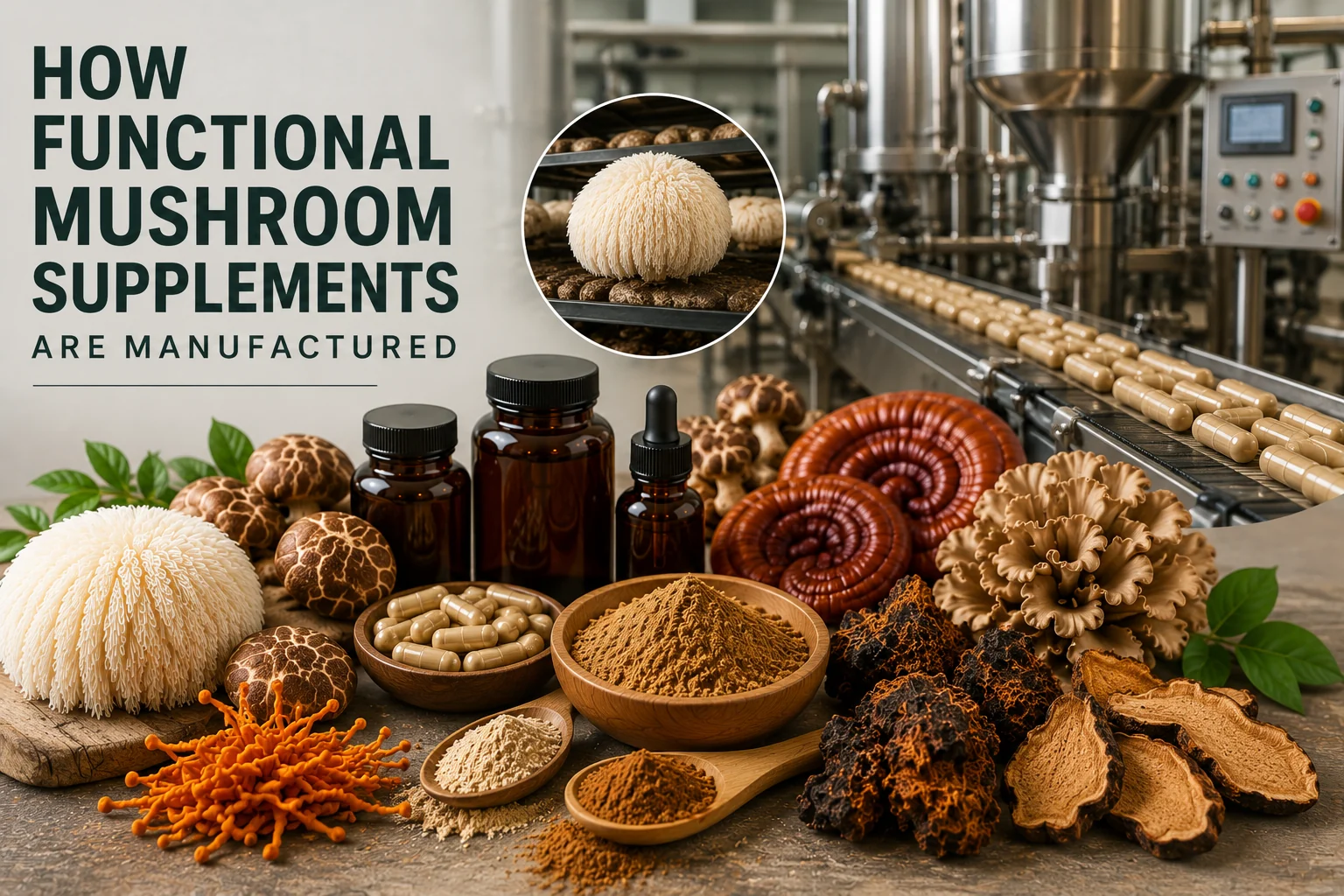
Consumers often see only the finished bottle of mushroom capsules on a store shelf, but behind every product lies a complex manufacturing process involving raw material selection, laboratory testing, extraction technology, precision equipment, and strict quality control.
For wholesale buyers and supplement brands, understanding this process is important because manufacturing standards directly affect product consistency, production efficiency, and long-term business success. Whether a company purchases mushroom powders, capsules, tablets, liquid extracts, or finished private label products, every production stage contributes to the final quality.
Modern functional mushroom manufacturing combines traditional knowledge of medicinal mushrooms with advanced industrial technology to produce safe, standardized products suitable for international markets.
Step 1. Selecting Premium Mushroom Raw Materials
The manufacturing process always begins with selecting suitable raw materials.
Depending on the product being manufactured, producers may work with dried fruiting bodies, mushroom powders, concentrated extracts, or other commercially prepared ingredients.
Raw materials are inspected before entering production to verify their identity, appearance, moisture level, cleanliness, and overall condition. Only materials that meet internal quality standards continue to the next manufacturing stage.
Reliable manufacturers also maintain traceability systems that allow every production batch to be linked back to its original raw materials.
Step 2. Cleaning and Preparation
Before further processing begins, mushroom materials are carefully prepared.
This stage may include:
removing unwanted particles;
additional cleaning;
sorting;
particle size adjustment;
controlled drying if required.
Proper preparation improves manufacturing efficiency while helping maintain consistent product quality throughout production.
Step 3. Grinding and Particle Size Control
For powdered products, mushrooms are milled into a fine, uniform consistency.
Particle size plays an important role because it affects:
blending efficiency;
capsule filling;
tablet compression;
product appearance;
packaging performance.
Industrial milling equipment allows manufacturers to achieve consistent powder characteristics across large production batches.
Step 4. Manufacturing Mushroom Extracts
Some functional mushroom supplements require extraction instead of simple grinding.
Extraction concentrates naturally occurring compounds and creates standardized ingredients suitable for dietary supplements.
Depending on the desired product, manufacturers may produce:
water extracts;
alcohol extracts;
dual extracts;
liquid extracts;
concentrated dry extracts.
Each production process is carefully monitored to maintain consistency between manufacturing batches.
Step 5. Blending Ingredients
Many finished supplements contain more than one ingredient.
At this stage manufacturers combine mushroom powders or extracts with other approved ingredients according to the final product specification.
Precision mixing equipment ensures every capsule, tablet, or serving contains the same ingredient distribution.
Uniform blending is essential for maintaining consistent product quality throughout large production volumes.
Step 6. Producing Finished Supplements
After ingredients have been prepared, production moves to the finished product stage.
Depending on customer requirements, manufacturers may produce:
capsules;
tablets;
gummies;
powdered drink mixes;
functional beverages;
bulk powder;
liquid products.
Modern automated equipment allows thousands of units to be manufactured every hour while maintaining strict production accuracy.
Step 7. Packaging Operations
Finished products are transferred to the packaging department.
Wholesale manufacturers usually offer multiple packaging solutions including:
bottles;
jars;
pouches;
bulk containers;
retail boxes;
custom packaging.
Packaging protects product quality during storage and transportation while presenting the finished brand to consumers.
Many manufacturers also provide complete Private Label packaging services with customer-specific artwork and labeling.
Step 8. Laboratory Quality Control
Testing continues throughout the entire manufacturing process rather than only at the end.
Quality control may include:
raw material verification;
in-process inspection;
finished product testing;
microbiological analysis;
heavy metal analysis;
moisture testing;
packaging inspection.
Continuous monitoring helps identify potential issues before products leave the factory.
Step 9. Documentation and Batch Release
Before products are shipped, manufacturing documentation is reviewed.
Each production batch may include:
production records;
quality inspection reports;
Certificates of Analysis (COA);
product specifications;
export documentation;
shipping records.
Complete documentation improves transparency while supporting international regulatory compliance.
Step 10. International Distribution
After quality approval, products are prepared for shipment.
Manufacturers coordinate packaging, palletizing, labeling, and logistics according to each customer's destination and transportation requirements.
Whether products are delivered domestically or exported internationally, careful logistics planning helps maintain product integrity throughout the supply chain.
Why the Manufacturing Process Matters
For supplement brands, manufacturing is much more than converting raw mushrooms into finished products.
A professionally managed production process provides:
consistent product quality;
predictable manufacturing timelines;
scalable production;
lower defect rates;
reliable documentation;
improved customer confidence;
long-term supply stability.
Companies that understand how supplements are manufactured are better equipped to evaluate suppliers and build successful long-term manufacturing partnerships.
Conclusion
Functional mushroom supplements undergo a carefully controlled production process that combines advanced manufacturing technology with comprehensive quality management. Every stage, from raw material inspection to final packaging, contributes to the safety, consistency, and reliability of the finished product.
For wholesale buyers, distributors, and supplement brands, partnering with an experienced manufacturer that follows standardized production procedures is essential for delivering premium mushroom products to the global market. Understanding the manufacturing process not only helps businesses choose the right supplier but also builds confidence in the quality and consistency of every product they bring to their customers.
Moving from research to sourcing? Compare our wholesale mushroom formats and review the documentation available for commercial orders.