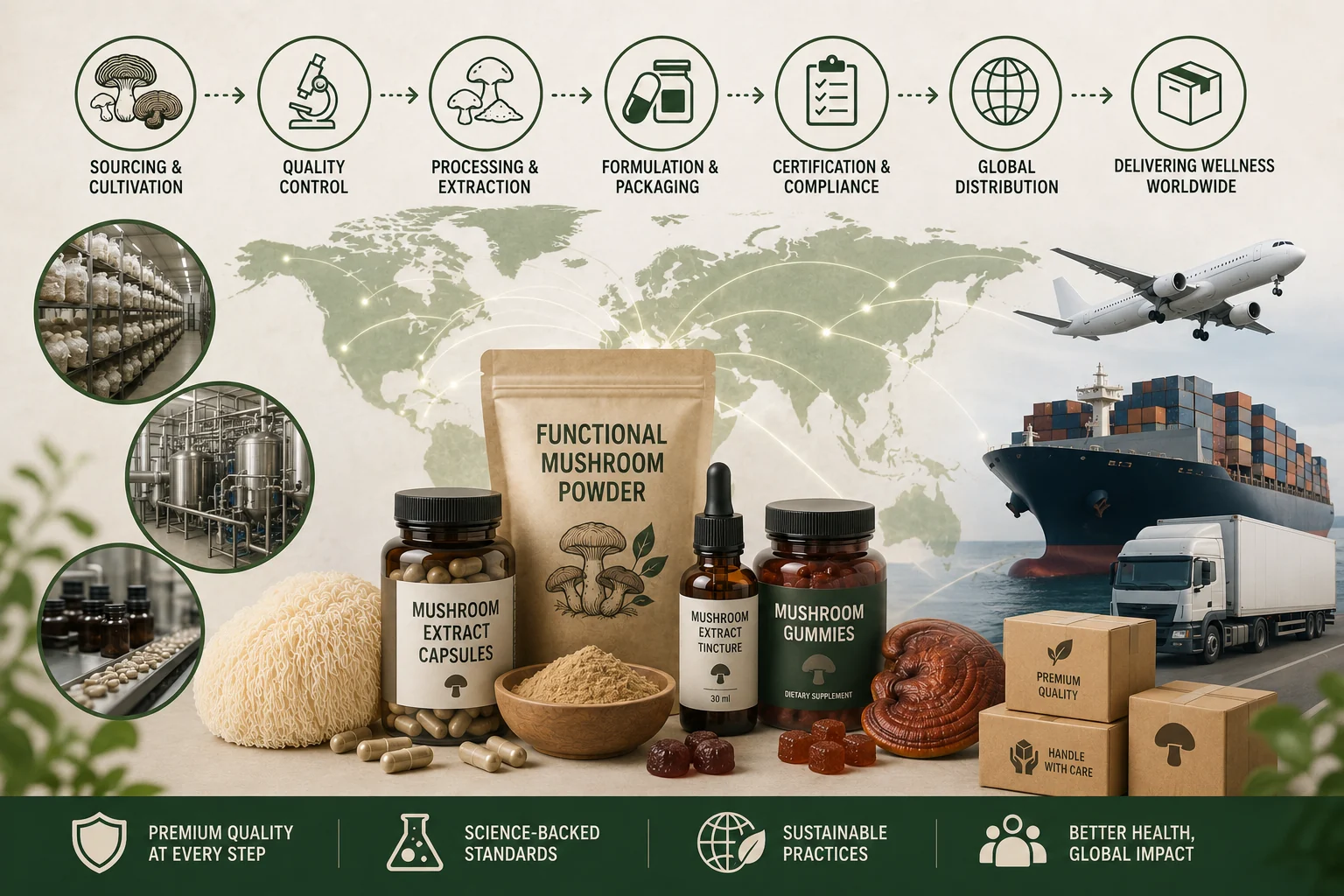
A bottle of mushroom capsules on a retail shelf may have traveled thousands of kilometers before reaching the customer. Long before it appears in a warehouse or online store, the product has already passed through multiple stages involving manufacturing, quality verification, export preparation, freight transportation, customs clearance, and commercial distribution.
For wholesale buyers, understanding this journey is valuable because every stage affects delivery reliability, inventory planning, and customer satisfaction.
Global distribution is not simply transportation—it is the coordination of dozens of business activities that must work together without interruption.
Every Supply Chain Starts with Production Planning
International shipments begin long before products are packaged.
Manufacturers first organize production schedules based on customer requirements, production capacity, and delivery deadlines.
During this stage they determine:
Production quantities
Manufacturing timeline
Packaging requirements
Label specifications
Shipping deadlines
Warehouse availability
Accurate planning ensures products are completed on time and ready for export without unnecessary delays.
Packaging Is Designed for International Transportation
Wholesale packaging serves a different purpose than retail packaging.
In addition to presenting the product professionally, export packaging must protect goods throughout international transportation.
Manufacturers carefully select packaging based on:
Product format
Shipment volume
Transportation method
Storage conditions
Destination requirements
Bulk powders, extracts, capsules, tablets, and finished consumer products often require different packaging systems to ensure they arrive in excellent condition.
Documentation Travels with Every Shipment
International trade depends on accurate documentation.
Before products leave the manufacturing facility, commercial paperwork is prepared to support customs processing and international transportation.
Typical export documentation may include:
Commercial Invoice
Packing List
Certificate of Analysis (COA)
Product Specifications
Certificate of Origin (when required)
Export declarations
Shipping documents
Preparing documentation correctly reduces the likelihood of customs delays and improves the efficiency of cross-border shipments.
Choosing the Right Transportation Method
Not every shipment follows the same route.
Transportation is selected according to delivery priorities, shipment size, destination, and customer requirements.
Wholesale mushroom products are commonly transported by:
Air freight
Ocean freight
Road transport
International courier services
Multimodal logistics
Each option offers different advantages in terms of speed, cost, and shipment volume.
Selecting the most appropriate logistics solution helps optimize both delivery time and transportation expenses.
Warehousing Plays a Strategic Role
Products rarely move directly from the factory to the final customer.
Many international supply chains include warehouses that support inventory management and regional distribution.
Warehousing provides several business advantages:
Faster local deliveries
Better inventory availability
Reduced shipping costs
Simplified order fulfillment
Improved distribution planning
Regional warehouse networks also allow brands to respond more quickly to customer demand.
Customs Is Part of Every International Shipment
Cross-border trade requires compliance with customs procedures in both exporting and importing countries.
Although regulations differ between markets, manufacturers and importers generally work together to ensure shipments are properly prepared before departure.
Successful customs processing depends on:
Accurate documentation
Correct product descriptions
Appropriate product classification
Proper packaging
Complete shipping information
Preparation before shipping is often the most effective way to minimize customs-related delays.
Distribution Networks Connect Manufacturers with Businesses
Once products have entered the destination market, they continue moving through commercial distribution channels.
Depending on the business model, products may be delivered to:
National distributors
Supplement manufacturers
Private Label brands
Retail chains
Online retailers
Health product wholesalers
Fulfillment centers
Each distribution channel requires different inventory planning and logistics strategies.
Strong distribution networks allow manufacturers to serve customers across multiple regions efficiently.
Technology Improves Global Supply Chains
International logistics has become increasingly data-driven.
Manufacturers and wholesale buyers now rely on digital systems to improve visibility throughout the supply chain.
Modern technologies support:
Production scheduling
Inventory management
Shipment tracking
Warehouse coordination
Order management
Delivery forecasting
Better information allows businesses to make faster purchasing decisions while reducing operational uncertainty.
Why Reliable Logistics Matter to Wholesale Buyers
For wholesale customers, product quality alone is not enough.
Reliable delivery performance influences:
Inventory planning
Product availability
Customer satisfaction
Distributor relationships
Business reputation
Sales continuity
A dependable logistics system ensures products arrive when expected, allowing businesses to maintain stable operations throughout the year.
Building an International Supply Partnership
Global trade is built on long-term cooperation rather than one-time transactions.
Successful manufacturers and wholesale buyers often develop partnerships that extend beyond production and include:
Demand forecasting
Inventory planning
Packaging optimization
Shipping coordination
New product launches
Market expansion
These partnerships improve efficiency for both sides while creating more resilient international supply chains.
Conclusion
Functional mushroom products reach global markets through a carefully coordinated process involving manufacturing, export preparation, transportation, warehousing, customs, and commercial distribution. Every stage plays a critical role in ensuring products arrive safely, efficiently, and on schedule.
For supplement brands, distributors, and wholesale buyers, understanding how international supply chains operate provides a competitive advantage. By partnering with experienced manufacturers that combine reliable production with strong logistics capabilities, businesses can reduce supply chain risks, improve delivery performance, and confidently expand into new international markets.
Planning cross-border supply? See how we coordinate international wholesale delivery and review the documentation available to buyers.